Every few quarters, video prospecting gets rediscovered as the tactic that will fix cold outbound. A rep records a thirty-second clip waving at a whiteboard with the prospect’s company name on it, the reply rate on that one email jumps, and suddenly the whole team is told to “do video.” Six weeks later the practice quietly dies, because nobody could keep producing personalized clips at the volume outbound actually requires.
Video is a real lever. It is also one of the most expensive personalization tactics you can run, measured in the one resource an outbound team never has enough of: rep time. The teams that get value from it are not the ones who do the most video. They are the ones who know exactly where in the sequence a video earns its cost, and who ruthlessly refuse to record one anywhere else.
Here is how to think about that decision.
Why video works when it works
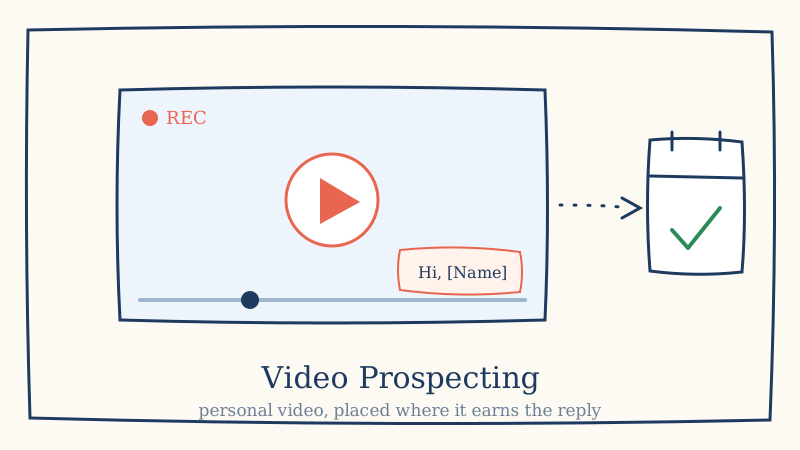
The mechanic behind video prospecting is not the video itself. It is proof of effort. A prospect who opens a cold email has been trained by thousands of prior emails to assume it is a blast. A video with their name on the screen, their website in the background, or a comment about their recent product launch is unfakeable evidence that a human spent real time on them specifically. That signal is what lifts the reply, not the production quality.
This is also why bad video underperforms plain text. A generic clip that could have been sent to anyone carries none of the effort signal and adds friction, because the prospect has to click, wait, and watch instead of skimming three sentences. If the video is not visibly personalized in the first three seconds, you have spent ninety seconds of rep time to make your email worse.
So the rule is simple. Video is worth it only when the personalization inside it could not have been written in text. If you could have said the same thing in a sentence, say it in a sentence.
Where video belongs in the sequence (and where it does not)
The instinct is to lead with video, because it feels like the strongest asset. That is usually wrong. The first touch in a cold sequence is where you have the least information and the worst odds, and spending your most expensive personalization on your lowest-probability contact is poor economics.
The better placements:
- Second or third touch, after an open. If a prospect opened your first email but did not reply, you now know two things: the address is real and the subject matter got past their filter. That is the moment a personalized video converts a warm-ish contact instead of gambling on a cold one.
- Post-engagement follow-up. Someone visited your pricing page, replied with a soft objection, or clicked a link. A video that references what they actually did lands far harder than one guessing at their pain.
- Multithreading into an account you are already working. When you have a live conversation with one stakeholder and want to reach a second, a short video referencing the existing thread signals that you are already inside, not cold-knocking.
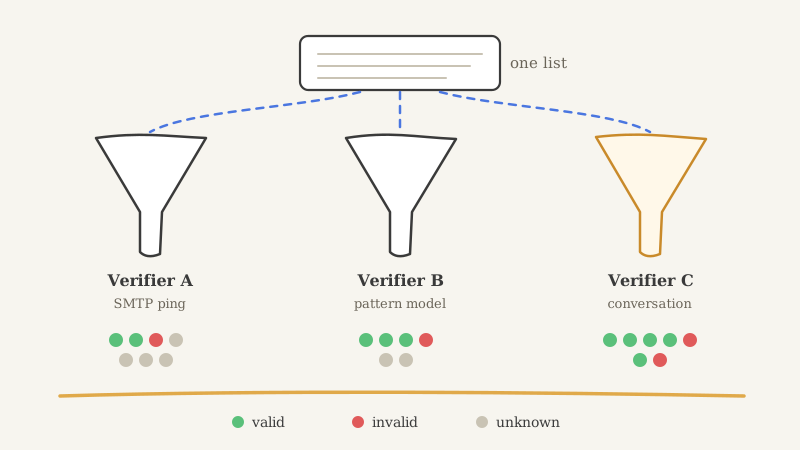
Where video does not belong: the very first touch to a purchased or scraped list, any contact whose email you have not verified, and any account where you have no genuine, specific observation to make. Recording video for unverified contacts is the worst trade in outbound. You cannot personalize your way past a bounce, so validate the list first with a service like Scrubby before a rep spends a minute filming. A verified, engaged contact is the only audience where the math on video works.
Producing video at outbound volume without burning the team
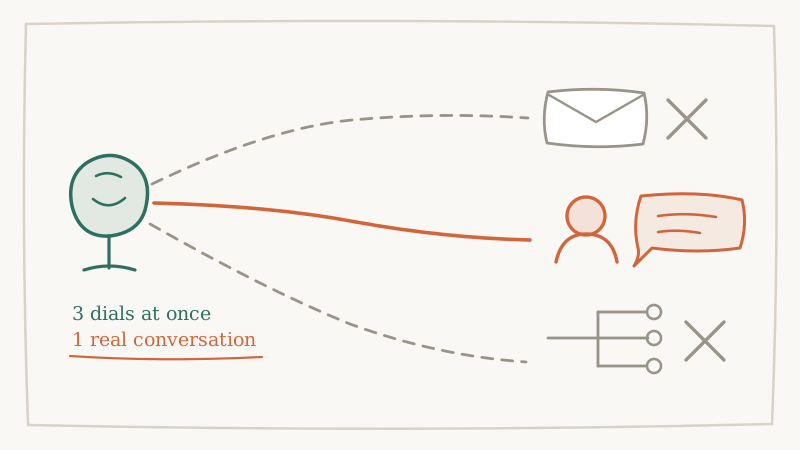
The reason video programs collapse is production cost, not idea quality. A rep who has to research, script, record, re-record, upload, and paste a link for every clip will manage maybe fifteen a day before the sequence work that actually fills the pipeline grinds to a halt. Solve the production bottleneck or do not start.
A few practices that keep it sustainable:
Standardize the structure so only the personal part changes. Every clip should follow the same skeleton: one personalized opener referencing something specific about them, one sentence of relevance (“teams like yours usually hit X”), one soft ask. When the frame is fixed, the rep only improvises the first ten seconds, which is the only part that carries the effort signal anyway.
Batch by segment, not by rep mood. Recording twenty videos for one ICP segment in a single sitting is far faster than context-switching across industries all day. The research overhead amortizes because the relevance line barely changes within a segment.
Cap the length hard. Thirty to sixty seconds. Past a minute, completion rates fall off a cliff and you are paying more production time for less watched content. The video is a door-opener, not the pitch.
Never re-record for polish. A slightly awkward, obviously-live clip outperforms a rehearsed one, because it reinforces that this was made for them and not produced by marketing. Perfectionism is the enemy of volume.
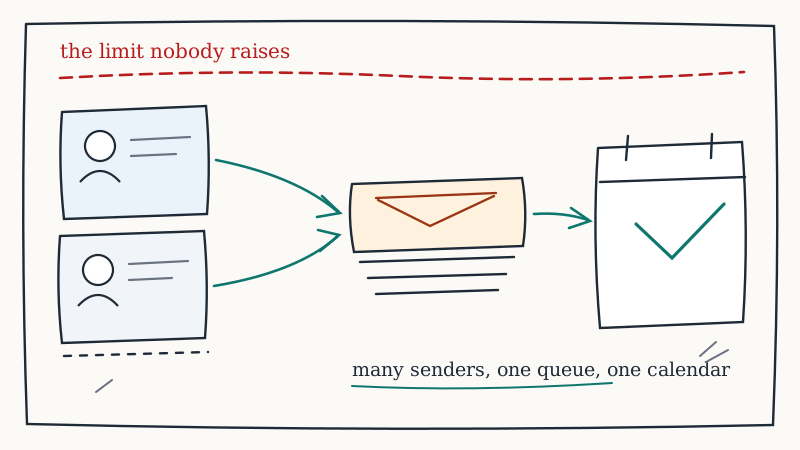
Separate production from the follow-up mechanics. The video’s only job is the reply. Booking, reminders, and calendar logistics should run on their own rails so a rep is not manually chasing times. Point interested prospects straight into a booking flow with a tool like Kali so the momentum from a good video converts into a held slot instead of dying in a scheduling back-and-forth.
The deliverability trap nobody warns you about
Here is the failure mode that quietly kills video programs: the video link itself hurts deliverability. Many video platforms auto-embed a thumbnail image and a tracked redirect link into your email. To a spam filter, a cold email from a new-ish domain that suddenly contains an image and a redirect looks a lot like the mail it is trained to catch. You can produce brilliant personalized clips and still watch open rates sink because the emails carrying them are landing in spam.
Two defenses. First, do not put video links in early cold touches at all, which the sequence placement above already handles, because you are only sending video to contacts who have already opened prior mail and proven the channel is clear. Second, treat video-bearing emails as a deliverability event worth monitoring, not a fire-and-forget send. If your sending domain or a video-platform domain lands on a blacklist, you want to know within hours, not after a month of silent decay. Continuous monitoring with a tool like CAM catches reputation and uptime problems on the assets your outbound depends on before they quietly erase a quarter of your sends.
The broader point: video sits on top of your infrastructure, it does not replace it. If your domains are not warmed, your list is not clean, and your authentication is not set up, adding video just gives you a more expensive way to land in spam.
Measuring whether video is actually earning its cost
The trap in measuring video is looking at the reply rate on video emails in isolation. Of course it is higher. You are sending video to your warmest, most-researched, already-engaged contacts, so it should beat your cold first-touch numbers by a wide margin. That comparison tells you nothing.
The number that matters is cost per meeting, fully loaded with rep production time. Run it as a real comparison: for the same segment and the same sequence position, does the video variant book more meetings per hour of rep time than a strong text-only variant? If a rep can send eighty personalized text emails or fifteen videos in the same hour, video has to book more than five times the meetings per email just to break even. Sometimes it clears that bar for high-value accounts. Often it does not for mid-market volume plays.
Segment the answer rather than making it global. Video frequently pays off on a short list of tier-one target accounts where each meeting is worth a great deal and the account count is small enough to justify the time. It rarely pays off as a blanket tactic across a large mid-market list, where the same rep hours produce more pipeline spread across more text touches. “Should we do video” is the wrong question. “For which accounts does video beat the alternative use of that rep’s time” is the right one.
The honest summary
Video prospecting is a precision instrument, not a volume tactic. It works when it delivers unfakeable proof of effort to a contact who has already shown a pulse, and it fails when it is bolted onto cold, unverified lists or treated as something every rep should do to every prospect. Put it in the second or third touch, aim it at verified and engaged contacts, standardize production so it does not eat the pipeline work, protect your deliverability, and measure it on fully loaded cost per meeting rather than vanity reply rates.
Do that, and video becomes a sharp tool for the accounts that deserve it. Skip the discipline, and it becomes the tactic your team tried for six weeks and quietly abandoned, again.
If you would rather have a team that already knows where each tactic belongs in the sequence, running the infrastructure, the list hygiene, and the measurement for you, that is the outbound operation Vendisys builds and runs on your behalf.